

What is the best exterior house paint to use in San Diego?
In terms of what exterior paint to use for San Diego homes, opt for an advanced, high-build elastomeric wall coating system rather than standard 100% acrylic exterior house paint. Due to intense coastal marine layers, corrosive ocean salt spray, alkaline stucco substrates, and severe inland thermal cycling (reaching 90°F to 105°F+ in East County valleys), standard acrylic paints break down within 3 to 5 years. A high-build elastomeric coating provides a Dry Film Thickness (DFT) up to 20 times thicker than retail paint, offers over 300% elongation to bridge seismic and thermal hairline stucco cracks, reflects solar radiation to reduce cooling loads, and features balanced vapor permeability (breathability) to prevent blistering while permanently protecting regional building envelopes.
Selecting an exterior coating in Southern California involves addressing unique regional weather factors that rapidly degrade standard building materials. When homeowners evaluate what exterior house paint to use in San Diego, they frequently discover that conventional retail formulas degrade quickly against local weather patterns. Deluxe Lifecote provides a specialized exterior coating system specifically engineered to replace conventional paint cycles with advanced, industrial-grade building envelope protection.
Understanding why standard retail coatings fail across the county requires a deep examination of local geology, microclimates, stucco chemistry, and coating physics. Whether maintaining a historic Spanish Colonial Revival in Mission Hills, a modern coastal residence in La Jolla, or a sprawling ranch home in Ramona, high-performance elastomeric coatings resolve the persistent structural and environmental challenges endemic to San Diego County.

Navigating San Diego Coastal and Inland Microclimates: The Failure of Standard Acrylics
San Diego County features some of the most complex, diverse microclimates in North America. Spanning from USDA Plant Hardiness Zones 9b through 11a, the region transitions within thirty miles from damp Pacific marine layers to hyper-arid foothill and desert microclimates. These distinct zones place severe, opposing mechanical and chemical stresses on exterior building assemblies.
Salt Spray and Marine Layer Exposure in Beach Communities
Coastal environments create a severe challenge for standard home finishes, exposing properties to continuous corrosive moisture.
- Persistent Marine Fog: Dense morning marine layers—frequently intensified during “May Gray” and “June Gloom”—deposit fine, saline moisture across exterior substrates in communities like Point Loma, Coronado, Ocean Beach, Pacific Beach, and Del Mar.
- Osmotic Blistering: Airborne sodium chloride and magnesium sulfate crystals lodge within standard acrylic pores. When relative humidity fluctuates, these hygroscopic salt crystals draw moisture through thin film coatings via osmosis, separating the paint film from the stucco beneath.
- Alkaline Attack and Efflorescence: Porous exterior plaster drinks in damp, saline air. As this internal moisture evaporates through thin topical paint, it pulls free calcium hydroxide (Ca(OH)2Ca(OH)_2Ca(OH)2) out of the Portland cement matrix, creating unsightly white crusts (efflorescence) that fracture standard paint bonds.
- Cure Inhibition: High ambient humidity (often exceeding 80% to 90% along the coast) prevents thin retail acrylics from undergoing complete coalescence, leaving the cured film soft, water-sensitive, and prone to dirt pick-up and mildew colonization.
- Wind-Driven Coastal Rain: Winter squalls drive moisture straight through unsealed hairline fissures in conventional wall finishes, causing structural rot within hidden wood framing and wire lath.
Standard exterior house paints deliver an average Dry Film Thickness (DFT) of only 1.5 to 2.5 mils per coat (equivalent to a sheet of standard copy paper). Under constant maritime exposure, this ultra-thin barrier oxidizes rapidly. Deluxe Lifecote’s specialized exterior coating service incorporates deep chemical de-salting, comprehensive surface repair, and an ultra-thick elastomeric barrier designed to shield coastal architecture from chloride ion penetration and structural corrosion.
Thermal Cycling and Solar Radiation Across Inland Valleys
Moving east over the coastal mesa into inland valley regions like El Cajon, Santee, San Marcos, Poway, and Escondido reveals an entirely opposite set of environmental hazards.
- Extreme Diurnal Thermal Shifts: Inland valleys regularly encounter summer afternoon temperatures exceeding 95°F to 105°F, followed by steep evening drops down to 55°F or 60°F. This creates continuous thermal shock and rapid movement cycles within exterior substrates.
- Severe Ultraviolet Degradation: Unfiltered solar irradiance breaks down organic chemical binders in standard retail paints through photodegradation, leading to color shift, surface chalking, and premature embrittlement.
- Substrate Expansion and Contraction: Stucco, wood framing, and structural metal components possess divergent coefficients of thermal expansion. The resulting shear stresses tear rigid, inelastic coatings across large wall planes.
- Brittle Acrylic Fractures: Traditional 100% acrylic formulas cure into non-elastic films. As building walls move under extreme thermal cycling, these thin films develop networks of micro-fissures and spiderweb cracks.
- Abrasive Santa Ana Scouring: During autumn and winter Santa Ana wind events, dry offshore winds from the Great Basin sweep across East County, blowing fine mineral particulates and silica dust that scour and erode weakened, sun-baked paint films.
For property owners deciding what exterior house paint to use in San Diego, standard store-bought paints represent an endless loop of scraping, prepping, and repainting every three to five years. Deluxe Lifecote resolves these microclimatic swings by installing an advanced exterior coating engineered for extreme solar resilience, structural flexibility, and thermal stability.
Engineering Durability: 20x DFT and 300%+ Elongation for Stucco Protection
Southern California residential construction relies heavily on exterior cementitious stucco (traditional three-coat plaster over wire lath). While exceptionally durable and fire-resistant, stucco is an inherently brittle, porous material with low tensile strength. Evaluating what exterior house paint to use in San Diego points directly to elastomeric polymer chemistry designed to bridge ongoing structural movement.
Mitigating Substrate Movement and Hairline Fissures
Stucco surfaces are subject to continuous mechanical stress generated by environmental and geological dynamics across the region:
- Tectonic and Seismic Settlement: San Diego sits within an active fault network (including the Rose Canyon, Elsinore, and San Jacinto fault zones). Micro-tremors and constant tectonic adjustments cause subtle movements beneath residential plaster layers.
- Expansive Clay Soils: Many San Diego communities—including Rancho Bernardo, Tierrasanta, Chula Vista, and Mount Helix—feature expansive adobe clay soils that swell dramatically when wet and shrink during drought, causing ongoing foundation settlement and structural wall shifting.
- Differential Thermal Movement: Wood structural studs expand and contract at different rates than the Portland cement stucco membrane attached to them, producing mechanical shear tension across wall elevations.
- Embrittlement of Traditional Paints: Standard store-bought paints dry into rigid coatings with an elongation capacity of under 20% to 50%. The moment a stucco fissure widens past a fraction of a millimeter, standard acrylic film splits.
- Moisture Intrusion Pathways: Unsealed cracks invite seasonal rain to track directly into the wall assembly, corroding galvanized steel lath nails, rotting structural OSB and shear walls, and promoting toxic black mold growth within wall cavities.
To deliver permanent stucco protection, Deluxe Lifecote utilizes an engineered coating matrix that achieves over 300% elongation. This exceptional elasticity allows the cured membrane to act as a resilient rubber-like skin, stretching and compressing over moving substrate cracks without tearing, pulling away, or shearing from the masonry wall.
High-Build Application Versus Conventional Paint Layers
Film build is the primary technical metric separating short-lived cosmetic paint from commercial-grade building envelope protection. Film thickness is measured in mils.
What Exterior Paint to Use for San Diego: Comparison Matrix
| Performance Attribute | Standard Retail Acrylic House Paint | Premium “Stucco Formula” Paint | Deluxe Lifecote High-Build Elastomeric Coating |
|---|---|---|---|
| Dry Film Thickness (DFT) | 2 – 3 mils total | 4 – 6 mils total | 20 – 40 mils total (up to 20x thickness) |
| Elongation / Elasticity | 20% – 50% (Brittle) | 75% – 120% (Semi-flexible) | 300%+ (High elongation memory) |
| Crack Bridging Capacity | Fails at cracks > 0.1 mm | Bridges hairline cracks up to 0.3 mm | Bridges active fissures up to 1.6 mm (1/16″) |
| Moisture Permeability | 5 – 10 Perms (Variable) | Traps water or admits liquid rain | 12 – 18 Perms (Optimal dynamic breathability) |
| Solar Reflectance Index (SRI) | Typically low to moderate (Rapid fade) | Moderate initial SRI (Declines in UV) | High SRI with cross-linked ceramic reflective spheres |
| Salt & Alkali Resistance | Poor; vulnerable to efflorescence | Moderate; degrades under salt mist | Immune to chloride ions & high pH stucco (pH>10) |
| Expected Lifespan | 3 – 5 years in San Diego climates | 5 – 7 years before failing | Permanent protection / Lifetime performance |
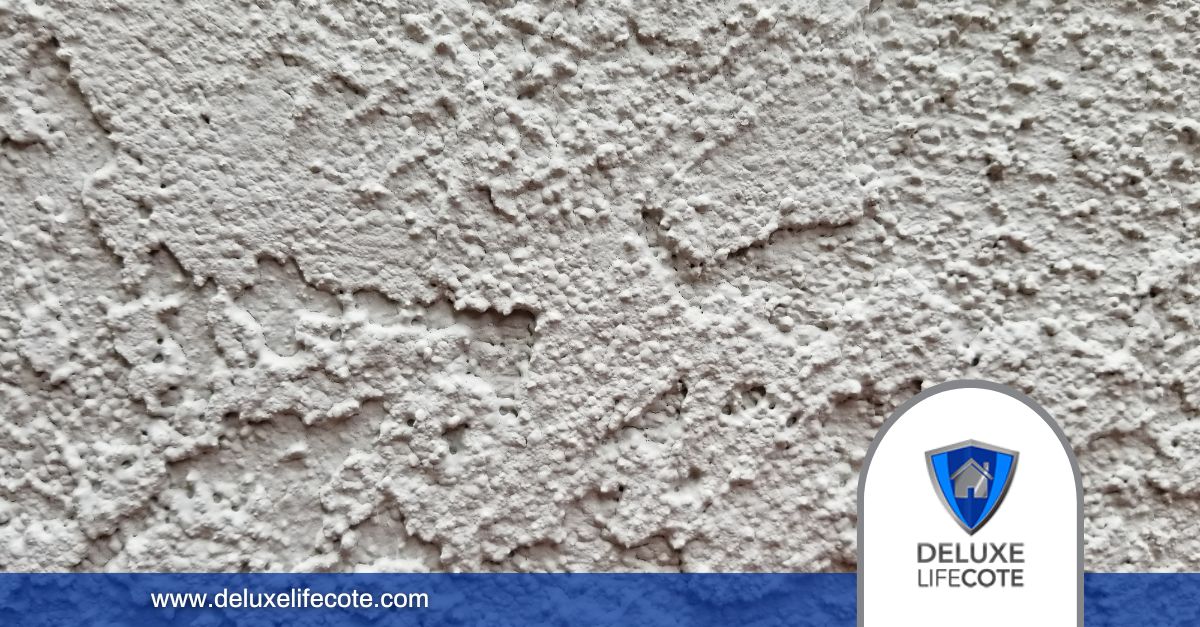
Thermal Reflectance and Vapor Permeability: A Permanent Paint Alternative
Preserving home structural integrity and long-term value requires managing both heat transfer and moisture migration across the building envelope. When San Diego property owners evaluate what exterior house paint to use, energy efficiency and wall respiration emerge as critical performance criteria. Deluxe Lifecote’s specialized exterior coating system addresses both factors simultaneously through advanced chemical engineering.
Solar Heat Defense and Cooling Load Mitigation
Prolonged summer heat throughout inland San Diego creates heavy electrical loads on residential HVAC systems.
- Solar Heat Gain: Dark and mid-tone conventional exterior paints absorb up to 80% to 90% of incident solar radiation, transferring heat directly into exterior stucco, structural studs, and living spaces. You can learn more about this from the California Energy Commission.
- Thermal Mass Delay: Heavy stucco walls absorb heat throughout the day and slowly radiate that stored thermal energy inward long after sunset, forcing air conditioners to run continuously late into the night.
- Rising Energy Costs: In SDG&E service territories—which carry some of the highest residential electric utility rates in the country—heavy air conditioning usage leads to steep seasonal power bills.
- Ceramic Core Technology: Deluxe Lifecote integrates advanced ceramic compounds and heat-mitigating pigments that actively reflect ultraviolet and infrared solar wavelengths away from the building envelope.
- Reduced Surface Temperatures: By reflecting solar radiation before it penetrates structural framing, this advanced system lowers exterior wall temperatures by up to 30°F to 45°F, substantially reducing indoor heat gain and easing strain on cooling equipment.
Internal Respiration and Moisture Evacuation
While blocking exterior rain and ocean fog is critical, residential exterior wall assemblies must maintain continuous breathability.
- Internal Vapor Generation: Daily domestic activities—including cooking, bathing, laundry, and indoor heating—generate significant volumes of internal water vapor that migrate outward through drywall, insulation, and framing toward the exterior wall.
- The Peeling Paint Hazard: Low-quality or non-breathable sealers trap this escaping humidity behind an impermeable paint barrier. Under solar heating, trapped water vapor vaporizes, building hydrostatic pressure that causes large paint blisters, bubbles, and peeling sheets.
- Internal Structural Decay: Moisture locked within enclosed stucco cavities corrodes steel lath framing, rots sill plates, and creates an environment for mold and mildew colonies inside interior wall bays.
- The Dynamic Breathability Solution: Deluxe Lifecote’s coating system achieves an ideal perm rating (between 12 and 18 perms). This acts as a selective, one-way membrane: liquid rain, ocean fog, and salt mist are blocked on the outside, while interior water vapor transpires freely to the exterior atmosphere.
This balanced vapor permeability maintains dry, healthy structural wall cavities while safeguarding exterior plaster against blistering, flaking, or delamination.
Comprehensive Surface Preparation and Lifelong Exterior Performance
A high-performance elastomeric wall system is only as reliable as the preparation work underneath it. Deluxe Lifecote executes a comprehensive surface restoration protocol before applying any protective coatings, ensuring permanent adhesion to the substrate. Selecting what exterior house paint to use in San Diego is only half the equation; installation precision determines real-world durability.
Detailed Substrate Restoration and Primer Technology
- Industrial Hydro-Washing: High-pressure washing removes accumulated ocean salt crystals, road grime, mildew spores, atmospheric soot, and unstable, oxidized paint particles down to a sound substrate.
- Structural Plaster Restoration: Damaged, cracked, or spalling stucco is excavated, cleaned, and patched using specialized fiber-reinforced bonding mortars formulated to match existing wall textures seamlessly.
- Alkaline-Resistant Primer Barrier: Bare and patched masonry surfaces are treated with a deeply penetrating, 100% acrylic resin primer. This primer seals high-pH stucco (pH>10pH > 10pH>10), neutralizes free lime, and locks down porous plaster for permanent chemical adhesion.
- Precision Caulking and Joint Sealing: All window perimeters, door bucks, expansion joints, architectural penetrations, and roof transitions are sealed using commercial-grade elastomeric caulking capable of handling high dynamic joint movement without tearing.
- Property Protection and Masking: Surrounding vegetation, roofing materials, hardscapes, decorative stone, lighting fixtures, and windows are completely masked and shielded throughout the application process.
Pairing meticulous surface restoration with an advanced high-build formula prevents the delamination, peeling, and blistering common to standard repainting projects.
Sustainable Value: Eliminating the Repainting Cycle for San Diego Properties
Traditional exterior paint maintains acceptable performance for roughly three to five years before UV radiation and coastal moisture cause chalking, fading, cracking, and peeling. Homeowners trapped in this cycle face recurring contractor fees, messy prep work, and accumulating paint layers that eventually crack under their own weight.
To break this pattern, savvy homeowners prioritize long-term performance through professional residential exterior renovation solutions that seal the structure for good. Choosing a high-build elastomeric wall system transforms exterior maintenance from a recurring cost into an enduring home investment.
By investing in an advanced, high-build elastomeric coating system, San Diego property owners gain enduring architectural protection, lowered indoor cooling demands, and lasting curb appeal. Whether facing damp coastal salt fog or scorching inland sun, high-build elastomeric protection provides the definitive answer to what exterior house paint to use in San Diego.

What Exterior Paint to Use for San Diego Homes: FAQs
What exterior paint to use for San Diego homes?
The best exterior coating for San Diego homes is a commercial-grade, high-build elastomeric wall coating system rather than conventional exterior house paint. Elastomeric coatings offer up to 20 times the dry film thickness of retail paints, feature more than 300% elasticity to bridge cracking stucco, resist coastal salt air and efflorescence, and reflect intense inland solar heat to help reduce household cooling costs.
How often do you need to paint a house in San Diego?
Traditional exterior paint on San Diego homes typically lasts between 3 to 5 years before fading, chalking, or cracking due to coastal salt fog or inland UV exposure. In contrast, an engineered high-build elastomeric coating system provides permanent building envelope defense backed by lifetime performance, eliminating the need to repaint every few years.
Is elastomeric paint good for San Diego stucco homes?
Yes, elastomeric coatings are the ideal protective solution for San Diego stucco homes. Because stucco expands and contracts during daily thermal cycles and shifts during subtle seismic settlement, rigid acrylic paints crack easily. Elastomeric coatings stretch over 300% to bridge dynamic fissures, seal porous masonry against ocean salt spray, and remain vapor-permeable so moisture cannot become trapped inside exterior walls.
Can elastomeric exterior paint help lower air conditioning bills?
Yes, high-build elastomeric coatings formulated with ceramic reflective technology significantly reduce indoor heat gain. By reflecting infrared and ultraviolet solar radiation away from exterior walls, these coatings lower stucco surface temperatures by up to 30°F to 45°F, reducing cooling loads on air conditioning systems during hot summer months in inland San Diego communities.
What is the difference between elastomeric coating and standard exterior house paint?
Standard exterior house paint is a thin, decorative topical finish that dries to only 1.5 to 2.5 mils per coat, providing limited flexibility (20% to 50% elongation) and wearing down quickly in harsh environments. Elastomeric coatings are thick, structural waterproofing systems that cure to 20 to 40 mils dry film thickness (up to 20x thicker than paint), offer over 300% elongation to bridge cracks, and provide dynamic vapor breathability combined with solar reflectance.