

What is a crack resistant exterior house coating?
A crack resistant exterior house coating is a high-build, elastomeric wall defense system engineered to bridge moving fractures and dynamic substrate gaps. Applied at up to 20 mils dry film thickness with over 300% tensile elongation, it forms a flexible, vapor-permeable membrane that expands and contracts with structural settling and thermal shock—preventing the cracking, peeling, and moisture intrusion typical of standard exterior paint.
Homeowners across Southern California face an aggressive combination of environmental forces: high UV exposure across the Inland Empire, dense coastal marine layers rolling off the Pacific, alkaline Santa Ana windstorms sweeping through mountain passes, and seismic micro-tremors from active fault lines like the San Andreas, Newport-Inglewood, and San Jacinto zones.
These dynamic conditions subject residential wall finishes to ongoing stress. Regional construction relies heavily on Portland cement stucco, concrete masonry units (CMU), adobe brick, and composite fiber-cement siding. While durable, these rigid substrates expand, contract, and settle continuously. Standard exterior paint films fail to accommodate this movement, fracturing within three to five years.
Achieving permanent protection requires transitioning from thin, decorative cosmetic coatings to an engineered, monolithic building envelope.
Why Store-Bought Acrylics Fail While High-Build Coatings Endure
Traditional exterior house paints sold at retail home centers are decorative, liquid formulations designed for low-cost application rather than long-term structural defense. Standard acrylic latex paints contain up to 70% volatile carriers (water and solvents) that evaporate rapidly during curing. This leaves behind a razor-thin dry film thickness (DFT) of only 1 to 2 mils per coat—scarcely thicker than a piece of household plastic wrap.
Sun Defense
Under the intense sun of the San Fernando, Coachella, and Antelope valleys, this thin residual film breaks down quickly. Ultraviolet radiation degrades the low-grade vinyl-acrylic polymer binders through photodegradation, splitting the molecular chains and causing chalking, resin embrittlement, and micro-fissuring.
In contrast, high-solids elastomeric coatings utilize heavy concentrations of 100% cross-linking acrylic resins, ceramic microspheres, and UV-inert mineral solids. When cured, this matrix yields an ultra-thick, flexible membrane measuring up to 20 mils DFT—more than ten to fifteen times the thickness of standard retail paint. Rather than drying into an inflexible layer that fractures when the substrate moves, an engineered coating provides high tensile strength and long-term elasticity, moving with the wall rather than tearing away from it.
| Performance Attribute | Standard Retail Exterior Paint | Deluxe Lifecote Engineered System | Structural Impact & Mechanism |
|---|---|---|---|
| Dry Film Thickness (DFT) | 1.0 – 2.0 mils total[cite: 21] | 16.0 – 20.0 mils total[cite: 21] | Delivers impact defense and forms an impenetrable barrier against wind-driven moisture.[cite: 21] |
| Tensile Elongation | 20% – 50% (Rigid)[cite: 21] | 300% – 350% (Dynamic)[cite: 21] | Stretches across moving fissures without snapping under structural shear.[cite: 21] |
| Elastic Memory / Recovery | Poor (< 15% recovery)[cite: 21] | High (> 90% recovery)[cite: 21] | Contracts cleanly back to original form when cool temperatures return.[cite: 21] |
| Solids by Volume | 25% – 35%[cite: 21] | 55% – 68%[cite: 21] | Minimizes shrinkage during cure, preventing pinholes and hollow voids.[cite: 21] |
| Permeability (Breathability) | 2 – 5 Perms (Varies widely)[cite: 21] | 8 – 12 Perms (Balanced)[cite: 21] | Allows internal vapor exhaust while preventing liquid water intrusion.[cite: 21] |
| Expected Service Life | 3 – 5 Years before cracking[cite: 21] | Lifetime Permanent Guarantee[cite: 21] | Eliminates recurring scraping, pressure-washing, and repainting cycles.[cite: 21] |
Microclimates, Substrate Dynamics, and Thermal Shock
Southern California encompasses distinct climatic zones within small geographic spans: marine and coastal zones (Zone 1), interior coastal valleys (Zone 6/9), arid foothill regions (Zone 10/14), and high desert basins. These regional microclimates expose exterior wall assemblies to diverse environmental stresses:
The Physics of Thermal Shock
Thermal shock occurs when building surfaces experience rapid temperature fluctuations over short timeframes. On a 95°F summer afternoon in Riverside or Santa Clarita, direct solar exposure drives dark or unreflective stucco temperatures upwards of 160°F. When ambient evening temperatures plummet to 65°F—or when sudden desert winds cool the building face—the substrate rapidly contracts.
Every material possesses an inherent Coefficient of Linear Thermal Expansion (CLTE). Structural cement stucco, concrete, and timber framing expand and contract at different rates. Because conventional acrylic paint lacks the elongation to accommodate these uneven shifts, shearing stresses tear the paint film along substrate stress lines, producing web-like patterns of hairline fissures.
Expansive Soils and Seismic Settling
Beyond atmospheric temperature swings, regional geological profiles introduce mechanical stresses into building foundations. Expansive clay soils (such as montmorillonite and bentonite, common across Orange County, Los Angeles, and the Inland Empire) expand significantly when saturated by winter atmospheric river storms and contract during drought periods.
This cyclical ground movement causes foundation shifting, which concentrates stress at structural weak points—such as the corners of door frames, window headers, and floor-to-floor transitions. Minor regional seismic settling adds continuous micro-vibrations to these assemblies.
Rigid paints shear instantly under these conditions. A high-tensile elastomeric coating, however, acts as a protective structural membrane, absorbing minor substrate vibrations and bridging active settling fissures.
High-Build 300% Tensile Elasticity: Engineering Active Crack Defense
Preventing cracks across stucco, masonry, and siding requires dynamic elasticity and material volume. Deluxe Lifecote formulates its coating systems to achieve over 300% tensile elongation under ASTM D412 testing standards.
How does 300% tensile elasticity stop exterior cracks?
An elongation capacity of 300% means the cured membrane can stretch up to three times its original dimension before reaching its tensile breaking point. When a structural fissure expands due to foundation movement or thermal expansion, the coating flexes over the gap rather than tearing. Its built-in elastic memory then pulls the membrane back to its baseline profile when the fracture closes, keeping the exterior weather-tight.
- Active Void Bridging: The coating stretches across dynamic cracks that widen and narrow through seasonal cycles.
- Impact Cushioning: The high dry film thickness (averaging up to 20 mils) provides a durable buffer against wind-blown debris, hail, and physical abrasion.
- Elastomeric Memory: High-grade polymers resist deformation, returning to their original shape without sagging, creeping, or tearing.
- Stress Distribution: The elastic membrane disperses localized mechanical stress across a broader surface area, preventing single-point fractures along masonry joints and stucco lath transitions.
Vapor Permeability Mechanics: Eliminating Blisters and Trapped Moisture
A common cause of coating failure is moisture entrapment. Water intrusion does not always originate from exterior rain; it regularly stems from indoor humidity migrating outward through wall cavities, or from ground moisture pulled upward through foundations via capillary action.
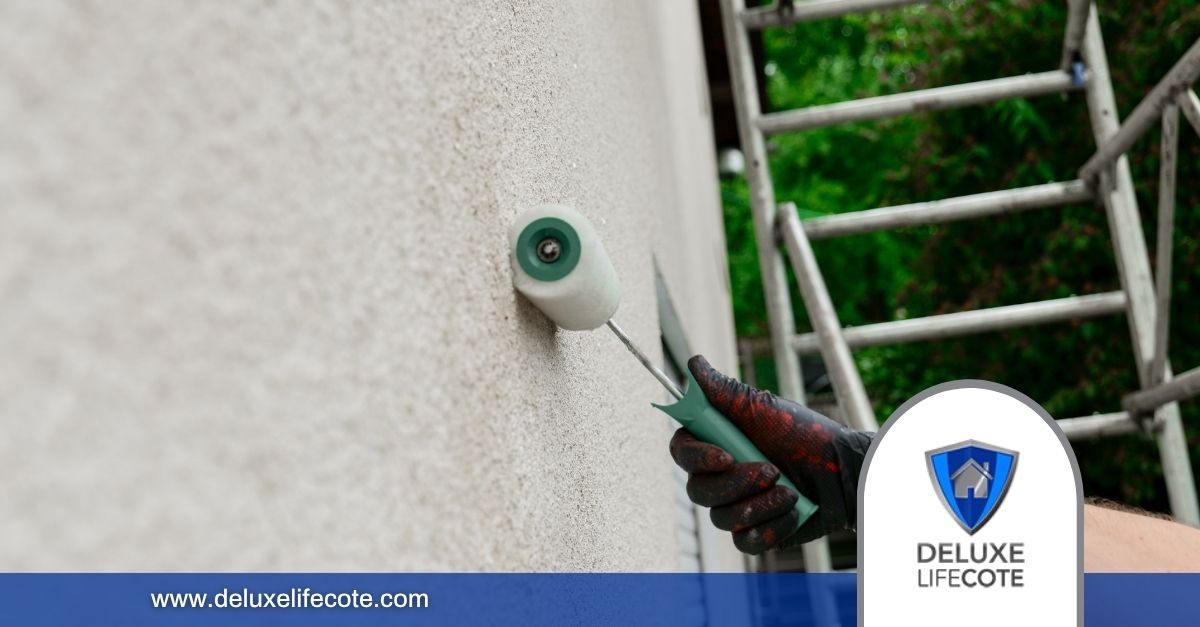
When an impermeable, non-breathable paint is applied over masonry or stucco, moisture vapor cannot escape. As solar radiation heats the wall, trapped water vaporizes, creating hydrostatic pressure behind the coating. This pressure breaks the adhesive bond, causing the paint to blister, bubble, and peel away in sheets.
Deluxe Lifecote addresses this issue through balanced vapor permeability. Calibrated to an 8 to 12 perm rating, the cured coating functions as a semi-permeable membrane:
- Outward Vapor Exhaust: Microscopic pores allow interior water vapor molecules to pass through and evaporate harmlessly into the ambient air, relieving hydrostatic pressure.
- Inward Liquid Barrier: The surface tension of liquid water droplets prevents external wind-driven rain, morning coastal dew, and fog from penetrating the wall assembly.
- Protection Against Spalling: By keeping the substrate dry, the system prevents efflorescence (salt leaching) and freeze-thaw spalling inside Portland cement stucco matrices.
Substrate Restoration, Mechanical Preparation, and Application Protocols
An elastomeric system requires sound structural preparation to perform as designed. Applying a coating over peeling paint, efflorescence, or unaddressed cracks leads to adhesive failure. Deluxe Lifecote utilizes structured surface preparation protocols to ensure optimal molecular bonding. Investing in specialized Deluxe Lifecote exterior solutions provides a systematic, multi-step installation process that addresses underlying substrate damage before the final coating is applied.
Solar Reflectivity and Energy Conservation Dynamics
In addition to crack resistance and waterproofing, an engineered exterior coating helps optimize home energy efficiency. Traditional dark or unreflective wall finishes absorb up to 90% of incident solar radiation, transferring heat directly into exterior wall framing, insulation batts, and interior living spaces.
- Near-Infrared Heat Reflection: Deluxe Lifecote coatings utilize reflective pigments and ceramic microspheres to bounce up to 85% of near-infrared rays back into the atmosphere before heat can be absorbed by the wall.
- Lower Substrate Surface Temperatures: Treated exterior walls can remain up to 40°F cooler under direct sunlight compared to surfaces coated with conventional acrylic paint.
- Reduced Cooling Demand: Lowering thermal heat transfer helps reduce the runtime of home air conditioning systems during peak afternoon hours, helping lower utility consumption and easing wear on HVAC equipment.
- UV-Resistant Mineral Pigments: Inorganic metal-oxide pigments resist ultraviolet radiation breakdown, preventing premature fading and maintaining consistent color across sun-exposed elevations.
Frequently Asked Questions About Crack Resistant Exterior House Coating
Can a crack resistant exterior house coating be applied over existing hairline cracks without patching?
Hairline fissures measuring less than 1/32-inch are bridged directly by the coating’s 20-mil film and 300% tensile elongation. However, cracks exceeding 1/16-inch are first routed and patched using flexible elastomeric patching compounds during prep work. This combined approach ensures the finished surface maintains a continuous, water-tight seal over active fractures.
How does elastomeric house coating differ from standard exterior stucco paint?
Standard paint cures to a thin, brittle film of 1 to 2 mils that fractures as structural substrates shift. Elastomeric coatings apply up to ten times thicker (16 to 20 mils DFT) and stretch over 300% without tearing. They also provide balanced vapor permeability, solar-reflective heat reduction, and a lifetime performance guarantee against cracking, chipping, and peeling.
Will high-build elastomeric coatings alter the architectural texture of stucco?
No. High-build elastomeric coatings follow the contours of Spanish lace, dash, sand, or heavy swirl stucco finishes without smoothing out their architectural character. The coating forms a uniform membrane over the surface, preserving its authentic profile while sealing the pores, micro-fissures, and voids where water enters.
How does the coating withstand coastal salt air and persistent marine fog?
Salt air and damp marine fog contain chloride ions that penetrate standard paint, accelerating stucco spalling and corroding internal metal lath framing. Deluxe Lifecote utilizes non-porous, hydrophobic polymer chains that prevent salt and moisture penetration while allowing internal vapor to vent, protecting homes along the coast from moisture damage.
Why is vapor permeability essential for Southern California masonry homes?
Vapor permeability prevents moisture entrapment. When ground dampness or indoor humidity migrates through masonry walls, non-breathable finishes trap that moisture behind the coating. As the hot California sun warms the wall, trapped water vaporizes into steam, generating hydrostatic pressure that causes large blisters and peeling paint. A balanced perm rating lets water vapor vent safely into the air.