

What is a Heat Reflective Exterior Wall Coating?
A heat reflective exterior wall coating is an engineered, high-build architectural envelope system embedded with inorganic ceramic microspheres and specialized solar-reflective pigments. Unlike conventional latex paint that absorbs infrared radiation, this coating reflects up to 85% of near-infrared solar wavelengths, dropping exterior wall surface temperatures by up to 37°F and significantly decreasing indoor thermal transfer and air conditioning loads.
Homeowners across Southern California face persistent solar radiation that drives summer utility bills to record highs while subjecting building envelopes to continuous thermal degradation. The combination of intense ultraviolet (UV) bombardment and high ambient temperatures breaks down standard architectural finishes within a few short years, turning exterior home maintenance into an expensive, recurring cycle.
Applying an advanced heat reflective exterior wall coating transforms how residential building materials interact with direct solar exposure. Rather than allowing exterior substrates like stucco, masonry, and fiber cement to soak up thermal energy, this advanced technology intercepts solar heat at the outer surface boundary.
Deluxe Lifecote provides homeowners with engineered exterior cladding protection designed specifically to withstand harsh regional microclimates—replacing standard paint cycles with a permanent, energy-efficient building envelope solution.
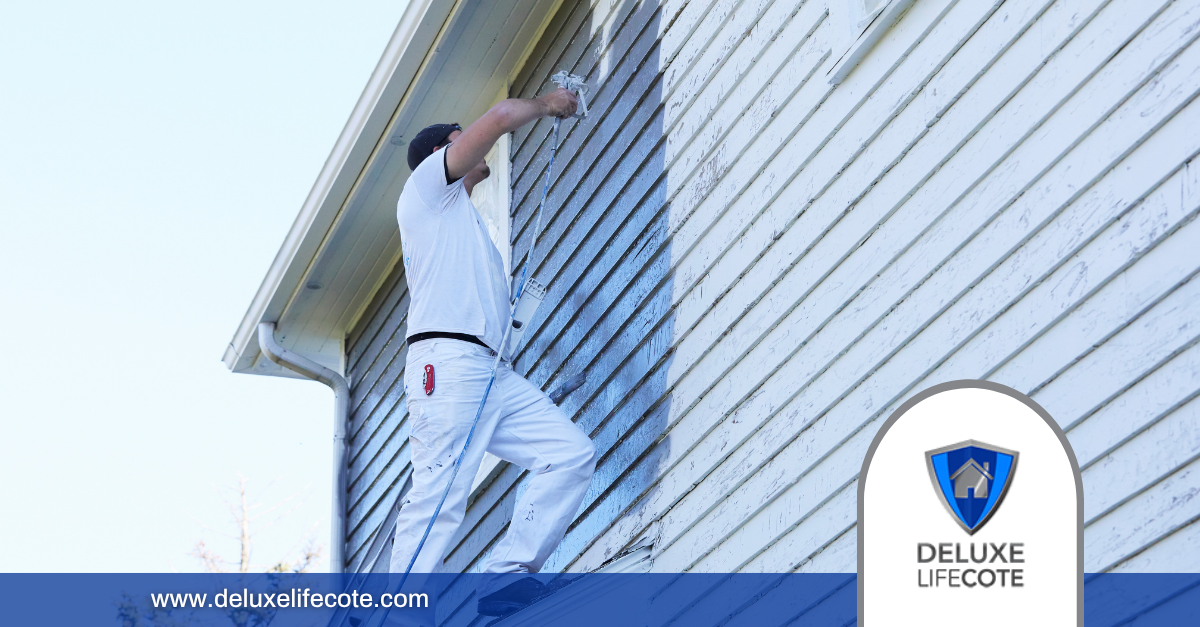
The Physics of Solar Heat Transfer: Near-Infrared Deflection
To understand how high-performance exterior wall coatings work, one must examine the electromagnetic spectrum. Sunlight reaches residential facades through three distinct components:
- Ultraviolet (UV) Rays (~5%): High-energy radiation that causes chemical bond breakage, binder burnout, fading, and chalking in exterior paint.
- Visible Light (~43%): The radiant band detected by the human eye, determining how dark or light an architectural color appears.
- Near-Infrared (NIR) Rays (~52%): Invisible wavelengths responsible for generating more than half of the total radiant heat accumulated on building surfaces.
Traditional exterior paints use inexpensive organic pigments and thin acrylic binders that absorb near-infrared energy. Once absorbed, this electromagnetic radiation accelerates molecular movement within the substrate, converting radiant energy into conductive heat. On a 100°F summer afternoon in an inland basin, a standard painted stucco wall can easily reach blistering temperatures between 140°F and 165°F.
Total Solar Reflectance (TSR) and Ceramic Microspheres
Engineered coatings resolve this thermal saturation by maximizing Total Solar Reflectance (TSR). TSR measures the percentage of all solar energy reflected away from an exterior surface across UV, visible, and NIR bands.
While conventional dark paints have TSR values as low as 5% to 15%, coatings enriched with inorganic ceramic microspheres and infrared-reflective pigments elevate TSR across the entire spectrum. These micro-engineered industrial spheres act like millions of microscopic mirrors embedded inside the resin film.
When incoming infrared wavelengths strike the coating, the microspheres deflect the radiant energy directly back into the upper atmosphere before it converts into sensible heat.
This surface deflection lowers exterior substrate temperatures by up to 37°F compared to standard retail paint exposed to identical ambient conditions. As a result, homeowners can select rich, contemporary, or darker architectural colors without converting their homes into solar heat sponges.
Overcoming Thermal Lag and Nighttime Heat Conduction
A persistent issue for residential properties across the Southwest is structural thermal lag—the delay between peak solar radiation hitting an exterior wall and that heat finally conducting through the wall assembly into living spaces.
Dense structural substrates such as masonry, concrete, brick, and three-coat Portland cement stucco have high thermal mass. During peak daylight hours (11:00 AM to 5:00 PM), these substrates act as thermal batteries, continually soaking up British Thermal Units (BTUs).
By the time the sun sets and outdoor ambient air cools down, the saturated building envelope begins releasing that stored energy inward through framing studs, fiberglass batt insulation, and interior drywall.
This inward heat release creates stifling hot zones along western and southern exposures, forcing air conditioners to cycle continuously long after dark.
By applying a durable, high-build barrier such as Deluxe Lifecote, homeowners prevent structural mass from reaching thermal saturation in the first place. Eliminating heat accumulation at the surface boundary keeps wall assemblies cool from morning through midnight, directly lowering baseline HVAC energy use.
Architectural Comparison: Heat Reflective Coating vs. Conventional Exterior Paint
Understanding the engineering differences between conventional retail exterior paint and specialized architectural wall coatings clarifies why standard repainting fails to solve indoor heat gain or exterior cracking.
| Metric / Architectural Feature | Conventional Retail Exterior Paint | High-Performance Heat Reflective Coating |
|---|---|---|
| Dry Film Thickness (DFT) | 1.5 to 2.5 mils per coat | 20 to 40+ mils (Up to 20x thicker) |
| Primary Solar Reflectance Mechanism | Basic titanium dioxide (white only) | Inorganic ceramic microspheres & NIR pigments |
| Surface Temperature Reduction | 0°F to 5°F baseline | Up to 37°F lower surface temperature |
| Tensile Elongation Memory | 20% to 50% (Brittle, fractures easily) | 300%+ dynamic elastic recovery |
| Resistance to Thermal Shock | Poor; cracks during diurnal shifts | High; expands and contracts with substrate |
| Vapor Permeability | Variable; often traps moisture | Breathable elastomeric matrix (perm rated) |
| Color Retention / UV Resistance | Fades and chalks in 3 to 5 years | UV-stable inorganic pigments; fade resistant |
| Typical Service Lifespan | 3 to 7 years before recoat is required | Permanent protective envelope (Lifetime system) |
Regional Microclimates and Local Environmental Stressors
Southern California features complex topographies where localized weather patterns subject exterior claddings to intense physical and environmental stress. A single architectural finish must endure diverse regional conditions across nearby communities:
- Inland Valleys & High Desert Basins (San Fernando Valley, Santa Clarita, Antelope Valley, Inland Empire): Communities in these regions routinely endure sustained triple-digit summer heat waves. Midday surface temperatures are exacerbated by regional urban heat islands—where asphalt roadways, concrete drives, and neighboring rooftops radiate secondary heat back onto residential facades. The extreme shift between 105°F midday sun and 60°F desert nights creates severe thermal shock, tearing brittle paint films apart.
- Foothill & Canyon Corridors (San Gabriel Foothills, Pasadena, Calabasas, Simi Valley): Canyon homes face intense, unshaded solar exposure on exposed hillsides, paired with seasonal, dry Santa Ana wind events that blow fine mineral dust and debris against building exteriors at high velocities.
- Coastal Plains & Marine Basins (Santa Monica, South Bay, Orange County Coastal Strip): Homes closer to the coast face lower maximum temperatures but endure heavy morning marine layers, persistent high humidity, and airborne ocean salts that accelerate moisture absorption and corrosion in porous stucco.

A heat reflective exterior wall coating addresses these regional stressors simultaneously. It deflects intense valley heat, accommodates dramatic desert diurnal expansion cycles, and resists coastal moisture absorption through a non-porous, weather-resistant barrier.
Elastomeric Flexibility: Preventing Thermal Stress Fractures
Beyond high heat transfer, rapid temperature changes cause physical movement in building envelopes. Under the laws of thermal physics, structural materials expand when heated and contract when cooled. In regions with dramatic day-to-night temperature swings, building envelopes experience continuous mechanical strain.
300%+ Tensile Elongation Memory
Standard retail house paints rely on cheap acrylic binders and chemical plasticizers. Under persistent UV exposure, these plasticizers quickly evaporate, leaving the paint film hard, brittle, and chalky. When the underlying stucco or masonry expands during a scorching afternoon, the rigid paint film cannot flex—resulting in spiderweb cracks, hairline splits, flaking, and eventual delamination.
Engineered heat reflective coatings are formulated with high-grade elastomeric resins that deliver over 300% tensile elongation memory. This property allows the coating to stretch dynamically with the moving substrate during peak midday expansion and return to its original structural form as temperatures drop at night.
Bridging Active Micro-Fissures and Moisture Vapor Transmission
Hairline fissures in stucco claddings do more than compromise aesthetics; they create direct conduits for wind-driven rain, atmospheric pollutants, and hot ambient air to penetrate wall cavities.
High-build heat reflective coatings bridge active micro-fissures, forming a unified, weather-tight shield over the building. At the same time, the coating maintains high vapor permeability (breathability). This ensures that normal moisture vapor generated inside the home can escape outward into the atmosphere, preventing trapped condensation from causing bubbling, blistering, or subsurface mold growth.
Applying an advanced coating as part of a complete residential exterior painting and coating restoration upgrades an aging structure into a resilient, climate-defending home.

Frequently Asked Questions About Heat Reflective Exterior Wall Coating Solutions
How does a heat reflective exterior wall coating differ from regular exterior paint?
A heat reflective exterior wall coating contains microscopic inorganic ceramic spheres and solar-reflective pigments that actively reflect near-infrared radiation away from the building. It is applied up to 20 times thicker than standard exterior latex paint and provides over 300% elongation elasticity to bridge cracks, while traditional paint relies on thin decorative pigments that absorb solar heat and crack under thermal stress.
Can a heat reflective coating lower indoor air conditioning costs?
Yes. By deflecting solar energy at the outer building envelope, heat reflective coatings reduce exterior wall surface temperatures by up to 37°F. This reduction stops thermal lag and cuts convective and conductive heat transfer into interior wall assemblies, reducing home cooling loads by up to 20% to 30% during peak summer months.
Does heat reflective coating work if I choose a dark exterior color?
Yes. Unlike conventional paint formulations where dark shades automatically absorb high levels of solar heat, heat reflective coatings use specialized inorganic pigments that reflect invisible near-infrared wavelengths (which account for over 50% of solar heat gain). This allows dark browns, deep grays, and earth tones to achieve high Total Solar Reflectance comparable to traditional light-colored paints.
How does elastomeric elasticity protect stucco walls against damage?
Building materials naturally expand and contract as outdoor temperatures fluctuate from day to night. Conventional exterior paint is rigid and fractures when the substrate moves, leading to micro-cracking and peeling. Elastomeric heat reflective coatings feature over 300% tensile elongation memory, allowing the coating to stretch and contract with the underlying stucco without splitting, cracking, or breaking its weather seal.
Is an engineered heat reflective coating a permanent solution?
Yes. While standard exterior latex paints degrade under UV radiation every 3 to 7 years, engineered architectural coating systems use UV-stable resins and ceramic components that resist binder burnout, chalking, and color fading. When installed by certified technicians with proper substrate repair and priming, these systems provide permanent, lifetime protection for residential envelopes.
Investing in an advanced heat reflective exterior wall coating addresses the fundamental physical forces that degrade residential buildings across Southern California. By deflecting invisible solar radiation, arresting the daily thermal lag cycle, and expanding dynamically across shifting substrates, this building envelope technology keeps living spaces comfortable while permanently protecting property value and architectural integrity.